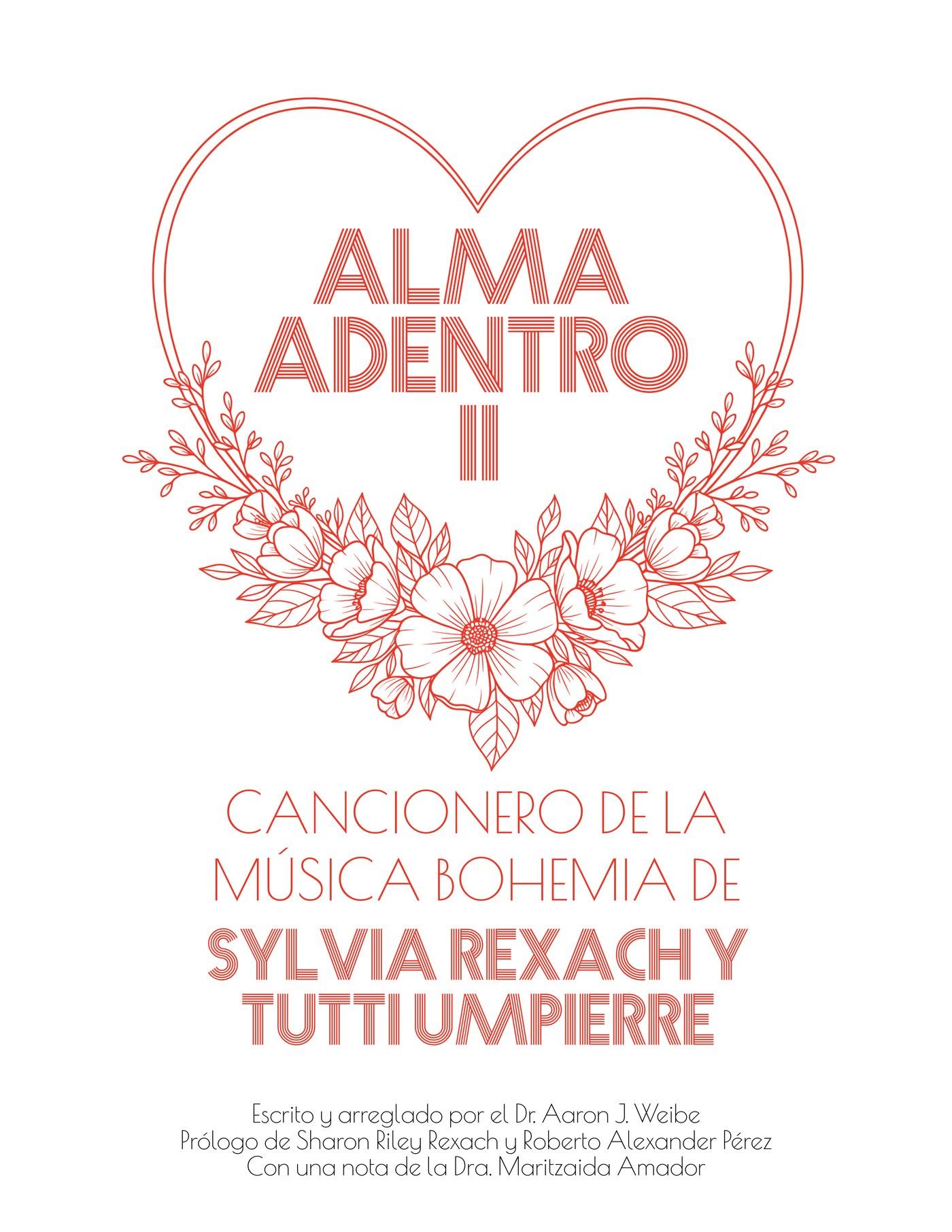
Half a century after the publication of Alma Adentro: Cancionero I, a new collection of the music of Puerto Rican composer Sylvia Rexach and guitarist and composer Tutti Umpierre is now available. Written and arranged by Dr. Aaron J. Weibe, Alma Adentro II: The Sylvia Rexach Cancionero brings together 44 compositions, including all 25 songs from the original publication, alongside historical accounts of their rediscovery, reconstruction, and preservation.
The original Alma Adentro was published around 1976–1978 through an effort led by Sylvia Rexach’s daughter, Sharon Riley Rexach. Intended to preserve her mother’s music while helping raise funds for her own daughter’s medical expenses, Sharon enlisted the assistance of Tutti Umpierre, who prepared the chords for the collection. The book, commonly known as the Sylvia Rexach Cancionero, was distributed throughout Puerto Rico but eventually became exceedingly difficult to find.
Alma Adentro II continues that preservation effort through a new collection of lyrics, chord arrangements, and personal stories documenting years of research and collaboration with the Rexach family.

The publication follows a multiyear recording project by Puerto Rican vocalist Maritzaida (Dr. Maritzaida Amador) and her husband, guitarist, arranger, and producer Dr. Aaron J. Weibe. Working closely with Sharon Riley Rexach, the duo has recorded 45 compositions from the catalog of Sylvia Rexach and Tutti Umpierre across five musical releases, distributed through SideHustle Records. Their work has drawn upon historical recordings, forgotten radio broadcasts, surviving manuscripts, and melodies preserved in Sharon’s memory, with the goal of preserving the repertoire in the intimate musical style of Sylvia and Tutti.
“We wanted Sharon, during her lifetime, to be able to hear gathered in one place the body of work she remembered watching her mother and Tutti create together,” Weibe writes. “That became one of our strongest reasons for finishing it.”
While some arrangements closely follow surviving historical recordings, others were reconstructed from incomplete sources or developed using the musical language Weibe learned through years of listening to Tutti Umpierre. The book presents the lyrics and chord arrangements using solfège notation (DO, RE, MI, FA, SOL, LA, SI), following the accessible approach of the original Cancionero. Rather than presenting traditional sheet music, the publication is designed to encourage musicians to explore and interpret the compositions themselves. Recordings by Maritzaida are also offered alongside the song sheets, allowing readers to hear the music while following the lyrics and chords.
Beyond the music, the publication documents the circumstances surrounding the rediscovery of individual songs, the people who helped preserve them, and the personal experiences of Maritzaida and Weibe throughout the project.
“This book is simply a record of what we found, what Sharon remembered, what Maritzaida and I created together, and everything I learned along the way,” Weibe writes.
For Maritzaida, who grew up in Isabela, Puerto Rico, listening to Sylvia Rexach’s music, the project has been as much a personal and cultural journey as a musical one.
“Every composition we have recovered has meant so much more than a musical discovery,” said Maritzaida. “Each has been an opportunity to reconnect with our history, to discover new dimensions of Sylvia, and to help ensure that her work continues to reach future generations.”
The book features a foreword by Sharon Riley Rexach and Roberto Alexander Pérez, along with a personal reflection by Maritzaida titled So Much More Than Music: A Legacy of Love, describing the profound personal significance of the project and the relationships that have developed throughout its creation.